
HRT for Women Under 40: Reclaiming Your Health and Future
The Essential Guide to Premature Ovarian Insufficiency & Early Menopause
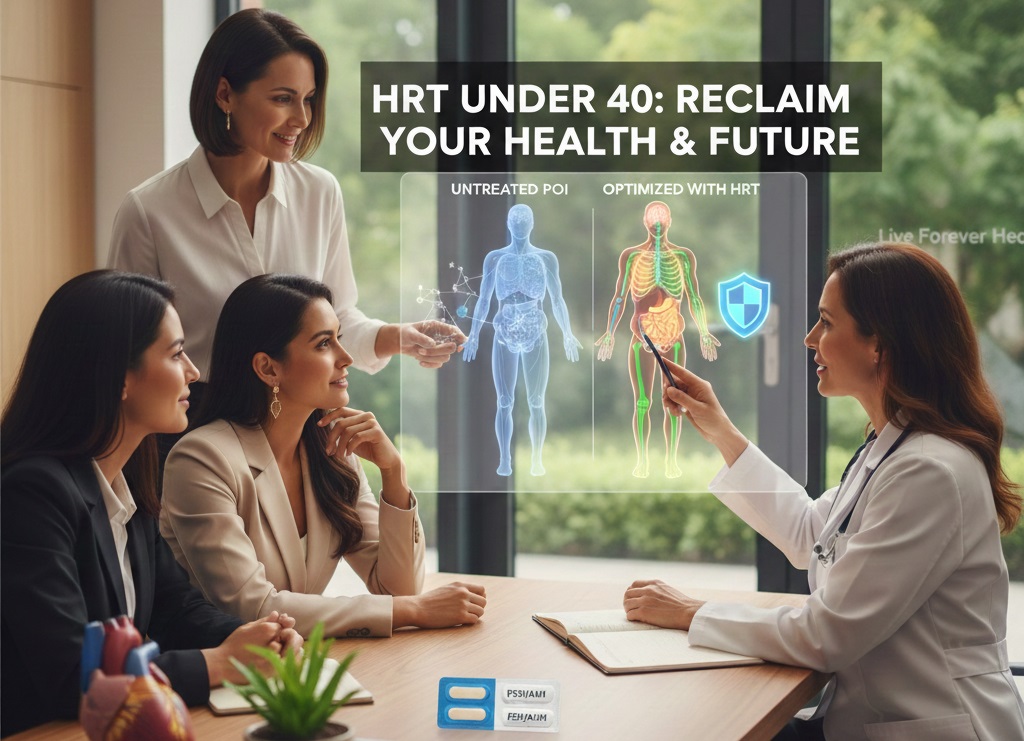
For women under 40, HRT is not an elective quality-of-life choice — it is a medical necessity. Premature Ovarian Insufficiency (POI, affecting ~1 in 30 women before age 40) and Early Menopause (ages 40–45, affecting ~12% of women by 45) create a 'hormone gap' that exposes the body to decades of estrogen deficiency during years it was biologically designed to have it. Without HRT, the risks include: accelerated bone density loss and significantly higher fracture risk; early-onset cardiovascular disease (hypertension, atherosclerosis); increased risk of cognitive decline and dementia. HRT for women under 40 is the recommended first-line treatment per international menopause guidelines and should continue until at least age 51 (average natural menopause age). The three pillars of HRT: (1) Estrogen — foundation of therapy, protects cardiovascular, skeletal, and neurological health; (2) Progesterone — required for all women with an intact uterus to prevent endometrial overgrowth from unopposed estrogen; micronized progesterone preferred for safety and sleep benefits; (3) Testosterone — often overlooked but critical for musculoskeletal strength, cognitive function, and libido. Preferred delivery: transdermal estrogen (patches, gels, sprays) bypasses liver first-pass metabolism, eliminating blood clot risk associated with oral tablets. Body-identical hormones have a more favorable safety profile than synthetic versions. Cancer risk: for women under 40 replacing hormones they should naturally have, breast cancer risk from modern body-identical HRT is extremely low — lower than risks from regular alcohol consumption or obesity.
Table of Content
- Introduction
- Defining the Terms: POI vs. Early Menopause
- The Statistics: The Scope of the Issue
- Why Under 40 is Different: The Medical Necessity
- Identifying the Symptoms (Beyond the Hot Flash)
- The Diagnostic Process: Why Testing is Mandatory
- The HRT Toolkit: Types and Methods
- HRT and Your Lifestyle
- Addressing the "Cancer Question" and Other Risks
- How to Advocate for Yourself
In the clinical landscape, menopause is often framed as a concern for the fifth decade of life. This narrative, however, overlooks a significant clinical population: women under the age of 40. When hormonal decline occurs prematurely, it is not merely a transition; it is a profound physiological shift that requires immediate medical attention to mitigate long-term health risks.
Understanding the distinction between these conditions and the biological necessity of intervention is the first step in shifting from "managing symptoms" to "preserving systemic health."
Experiencing Symptoms of Hormonal Decline?
Get a specialist's opinion. Don't leave your long-term bone, heart, and brain health to chance.
Defining the Terms: POI vs. Early Menopause
Clinically, it is essential to distinguish between these two diagnoses, as their trajectories can differ:
Premature Ovarian Insufficiency (POI)
This occurs when the ovaries cease to function normally before age 40. Unlike natural menopause, POI is not always a permanent, absolute cessation of ovarian activity. Ovarian function can be intermittent, meaning periods may occasionally return, but the state of chronic hormone deficiency remains a critical health concern.
Early Menopause
This is the clinical diagnosis for menopause that occurs between the ages of 40 and 45. Both conditions result in a "hormone gap"—a period where the body is deprived of the protective benefits of estrogen, progesterone, and testosterone decades earlier than biologically intended.
The Statistics: The Scope of the Issue
Women experience menopause or POI before age 40
Of women experience early menopause by age 45
A common misconception is that premature hormonal decline is rare. For women in their 20s and 30s, symptoms are frequently misdiagnosed as stress, depression, or thyroid issues because providers often assume the patient is "too young" for ovarian insufficiency. The statistics prove otherwise: this is a widespread medical reality that warrants a proactive diagnostic approach.
Why Under 40 is Different: The Medical Necessity
For women over 50, HRT is often presented as an elective choice for symptom management. For women under 40, the clinical consensus is different: HRT is a medical necessity.
Hormones as Life Support
Estrogen is not merely a reproductive hormone; it is a systemic regulator. In your 20s and 30s, the body relies on consistent estrogen levels to maintain:
Bone Remodeling
Regulating the balance between bone formation and resorption
Vascular Health
Promoting vasodilation and maintaining arterial elasticity
Neuroprotection
Supporting synaptic plasticity and glucose metabolism in the brain
The Long-Term Risks of Untreated POI
Leaving POI untreated creates a cumulative "hormone debt." The longer the body remains in a deficient state, the higher the risk for chronic conditions:
| Health Risk | Impact Without HRT |
|---|---|
| Osteoporosis & Fracture Risk | Accelerated bone density loss leading to significantly higher risk of hip and spinal fractures |
| Early-Onset Cardiovascular Disease | Increased risk of hypertension, atherosclerosis, and heart disease decades earlier than average |
| Cognitive Decline & Dementia Risk | Increased risk of cognitive impairment and certain types of dementia |
Explore Our Hormone Therapy Programs
Personalized hormone optimization designed specifically for women's unique health needs.
Learn More About HRTIdentifying the Symptoms (Beyond the Hot Flash)
While the "hot flash" is the hallmark symptom of menopause in popular culture, many women under 40 experience a much broader and more subtle constellation of symptoms. Because these patients are often at the peak of their careers or raising young families, early symptoms are frequently misattributed to burnout or psychological stress.
The Psychological Impact: The Brain-Hormone Connection
Anxiety & Irritability
Sudden, unexplained spikes in anxiety or a "short fuse" that feels out of character
Cognitive Dysfunction
Difficulties with word retrieval, executive function, and maintaining focus
Memory Lapses
Short-term memory disruptions affecting professional performance and daily organization
Systemic Physical Changes
- Musculoskeletal Pain: Generalized joint and muscle aches due to decreased lubrication and increased inflammation
- Dermatological Shifts: Thinning skin, loss of elasticity, and changes in hair texture or density
- Extreme Fatigue: Exhaustion not resolved by sleep, linked to HPA axis disruption
- Genitourinary Changes: Urinary frequency, vaginal atrophy, and impact on libido
The Diagnostic Process: Why Testing is Mandatory
For women under 40, biochemical confirmation is essential. Because other conditions can mimic POI, a comprehensive blood panel is required.
| Biomarker | What It Measures | POI Indication |
|---|---|---|
| FSH (Follicle-Stimulating Hormone) | Brain signals to ovaries | Above 25–30 IU/L (repeat test in 4–6 weeks) |
| AMH (Anti-Müllerian Hormone) | Ovarian reserve marker | Very low or undetectable levels |
| Estradiol | Active form of estrogen | Determines depth of deficiency |
The HRT Toolkit: Types and Methods
Modern Hormone Replacement Therapy is a sophisticated medical intervention that moves beyond "one-size-fits-all" dosing. For a woman under 40, the objective is physiological restoration—replicating the hormonal environment the body should naturally maintain.
The Three Pillars of Replacement
Estrogen
The foundation of therapy. Essential for mitigating vasomotor symptoms and providing primary defense for cardiovascular, skeletal, and neurological health.
Progesterone
Clinical requirement for anyone with an intact uterus. Protects the endometrial lining by preventing tissue overgrowth from unopposed estrogen.
Testosterone
Often overlooked but critical. Contributes to musculoskeletal strength, cognitive sharpness, and maintenance of libido.
Body-Identical vs. Synthetic Hormones
Body-Identical Hormones
Regulated medications with molecular structure identical to hormones naturally produced by human ovaries. More favorable safety profile regarding breast health and cardiovascular risk.
Synthetic Hormones
Older formulations that don't match natural molecular structure. May have different metabolic effects and safety profiles compared to body-identical options.
Delivery Systems: Optimization and Safety
💡 Key Insight: Route of Administration Matters
The route of administration is as important as the hormone itself, particularly concerning the risk of venous thromboembolism (VTE).
- Transdermal Delivery (Patches, Gels, Sprays)
Preferred clinical route. By bypassing the liver's "first-pass" metabolism, transdermal estrogen does not increase the risk of blood clots, making it safer than oral tablets.
- The Mirena Coil (IUS)
Can serve as the progesterone component. Provides localized protection to the uterine lining with minimal systemic absorption—ideal for patients who experience side effects from oral progesterone.
HRT and Your Lifestyle
Contraception vs. HRT: The Masking Effect
Many women in their 30s utilize the Combined Oral Contraceptive Pill (COCP). While the pill contains synthetic hormones, it is not the same as HRT. In many cases, the high synthetic doses in birth control can "mask" the symptoms of POI.
⚠️ Important Note:
Most HRT protocols are not contraceptive. If pregnancy prevention is still required, HRT must be paired with a non-hormonal option (like a copper IUD) or a localized progestogen system (like the Mirena coil).
Fertility Considerations: "Can I Still Get Pregnant?"
5% to 10% of women with POI may conceive naturally
In POI, ovarian function can be intermittent. Clinical data suggests some women may conceive naturally after diagnosis because the ovaries can sporadically release an egg. While HRT is not a fertility treatment, it supports overall systemic health.
HRT and Existing Conditions
Modern delivery methods have changed the contraindication landscape:
Addressing the "Cancer Question" and Other Risks
The "Window of Opportunity"
When HRT is started early—specifically before the age of 51—it is remarkably protective. For a woman under 40 with POI, the body is in a state of "estrogen hunger." Introducing hormones during this window helps maintain the health of blood vessels and breast tissue, significantly reducing long-term risks.
The Truth About Breast Cancer: Putting Risk in Perspective
| Risk Factor | Relative Risk Level |
|---|---|
| Body-Identical HRT (women under 40) | ✓ Extremely Low - Simply replacing hormones they should have naturally |
| Regular alcohol consumption (2+ units/day) | ⚠️ Higher than modern HRT protocols |
| BMI over 30 (obesity) | ⚠️ Significantly greater risk than modern HRT |
Most specialists agree: There is no "extra" risk of breast cancer up until at least the average age of natural menopause (51) for women with POI taking HRT.
📚 Related Reading: Understanding Estrogen & Progesterone
Learn more about how these critical hormones work in your body and why balance is essential for optimal health.
Read ArticleHow to Advocate for Yourself
Navigating the healthcare system as a woman under 40 can be challenging. Because the average age of menopause is 51, many general practitioners may not immediately consider hormonal insufficiency as a primary diagnosis. Advocacy, backed by clinical data, is essential.
The Doctor Conversation: Overcoming the "Too Young" Bias
📋 Request Specific Diagnostics
Don't settle for "wait and see." Explicitly ask for FSH, Estradiol, and AMH blood tests. Insist on repeat testing in 4–6 weeks if FSH is elevated.
📝 Document Your Symptoms
Keep a detailed log of physical and psychological changes. Present clear patterns to move from "subjective stress" to "objective clinical indicators."
📚 Cite the Guidelines
International menopause guidelines state HRT is the first-line treatment for women under 40 with POI unless a clear contraindication exists.
The "Age 51" Rule
Current clinical consensus recommends that women with POI or early menopause should remain on HRT until at least age 51, the average age of natural menopause. This ensures your bones, heart, and brain receive necessary hormonal protection during the years they were biologically designed to have it.
Conclusion: The Path Forward
HRT for Women Under 40 is far more than a treatment for "old age." It is a vital clinical tool used to reclaim quality of life in the present while proactively securing long-term systemic health.
A diagnosis of Premature Ovarian Insufficiency or early menopause does not represent a loss of vitality; rather, it marks the beginning of a specialized health journey focused on optimization and longevity. By bridging the "hormone gap" with precise, medically supervised replacement, you can effectively mitigate the risks of osteoporosis, cardiovascular disease, and cognitive decline.
The Gold Standard in Hormone Optimization
At Live Forever Health, we specialize in the complex science of hormonal health with over 25 years of medical expertise.
Comprehensive Diagnostics
Over 2,000+ biomarkers analyzed for your hormonal blueprint
Expert Medical Oversight
Board-Certified Physicians specializing in hormone optimization
Accessible Care
Telemedicine in all 50 states with 24/7 medical support
Proven Results
85% of patients see measurable results within 3 months
Take Control of Your Health Today
Join 2 million+ subscribers who trust Live Forever Health for their wellness journey